THE STORY
The Chạm Sắc story
One hat – Three crafts – One story. A journey that brings the Chuông hat together with Vạn Phúc silk and Hạ Thái lacquer, with the women and girls of the craft village at its heart.
01
A letter from the founder
Born and raised in Hanoi, I was lucky that my parents let me learn painting, dance and the violin, and took me to water-puppet shows, concerts and exhibitions. Little by little I came to see everything through colour and sound. In that world one image kept returning: the Vietnamese woman in an áo dài and a conical hat.
Both are symbols of gentle, graceful beauty. But while the áo dài is known worldwide as the national dress, the conical hat is quieter and often overlooked by young people — even though it has followed our mothers and sisters to the fields, the markets and the festivals, and into folk verse, poetry and music.
What troubled me is that this hat has shone on international catwalks and magazine covers, yet at home the people who make it still struggle to earn a living.
Visiting Chuông village again and again, following the women to the early-morning hat market, I saw the care behind it: palm leaves rubbed with sand, sun-bleached to silver and pressed flat; a brim shaved from bamboo with 16 rings; perfectly even stitches with every joint hidden. Each hat takes at least five hours, yet even the finest sells for only about 100,000 đồng.
In the village I had the good fortune to meet People’s Artisan Tạ Thu Hương, who keeps the craft alive, created the silk hat and has taken Chuông hats to Japan, Korea and Europe. In her eyes I still saw her deep concern for the craft.
President Hồ Chí Minh taught: “The young do small things, according to their strength.” So what can a young person like me do? From that question came the idea: let the Chuông hat join hands with the finest of other craft villages.
02
Chuông village today
Chuông village (now part of Thanh Oai commune, Hanoi) has been famous for its conical hats for hundreds of years. A Chuông hat is known for its finesse: perfectly even stitches, hidden joints, white and flat leaves.
But the craft is quietly fading. Where some 4,000 households once made hats, only about 1,000 remain. A maker usually finishes just one hat a day, selling it for 50,000–60,000 đồng; the craft brings in only around 1.5–2 million đồng a month.
Palm leaves from central Vietnam are getting scarce, the makers are ageing and young people are leaving. Most products are still traditional hats, with no creative line for gifts, fashion, collectors or international visitors.
Chuông village does not lack skilful hands. What it lacks is a place for the traditional hat in modern life and taste. That is the gap Chạm Sắc wants to fill.
03
Discover Chuông hat village
Chuông village lies in Thanh Oai commune, about 30 km from central Hanoi, reached by National Route 21B or the Đáy river dyke road. An old folk verse — “Chuông hats, Khua silk, Đơ village straps” — hints at how long the craft has lived here; villagers say hats have been made since the eighth century, when the village was still called Trang Thì Trung.
In the village you can watch the whole process in family courtyards: palm leaves dried in three days of sun, rolled soft, aired and heated until they turn golden; a frame shaved from bamboo that grows along the Đáy dyke, wound into 16 rings; then the leaves stitched on with every knot hidden — the signature skill of Chuông. A finished hat is held over sulphur smoke to whiten it and keep off mould, sometimes brushed with oil for shine.
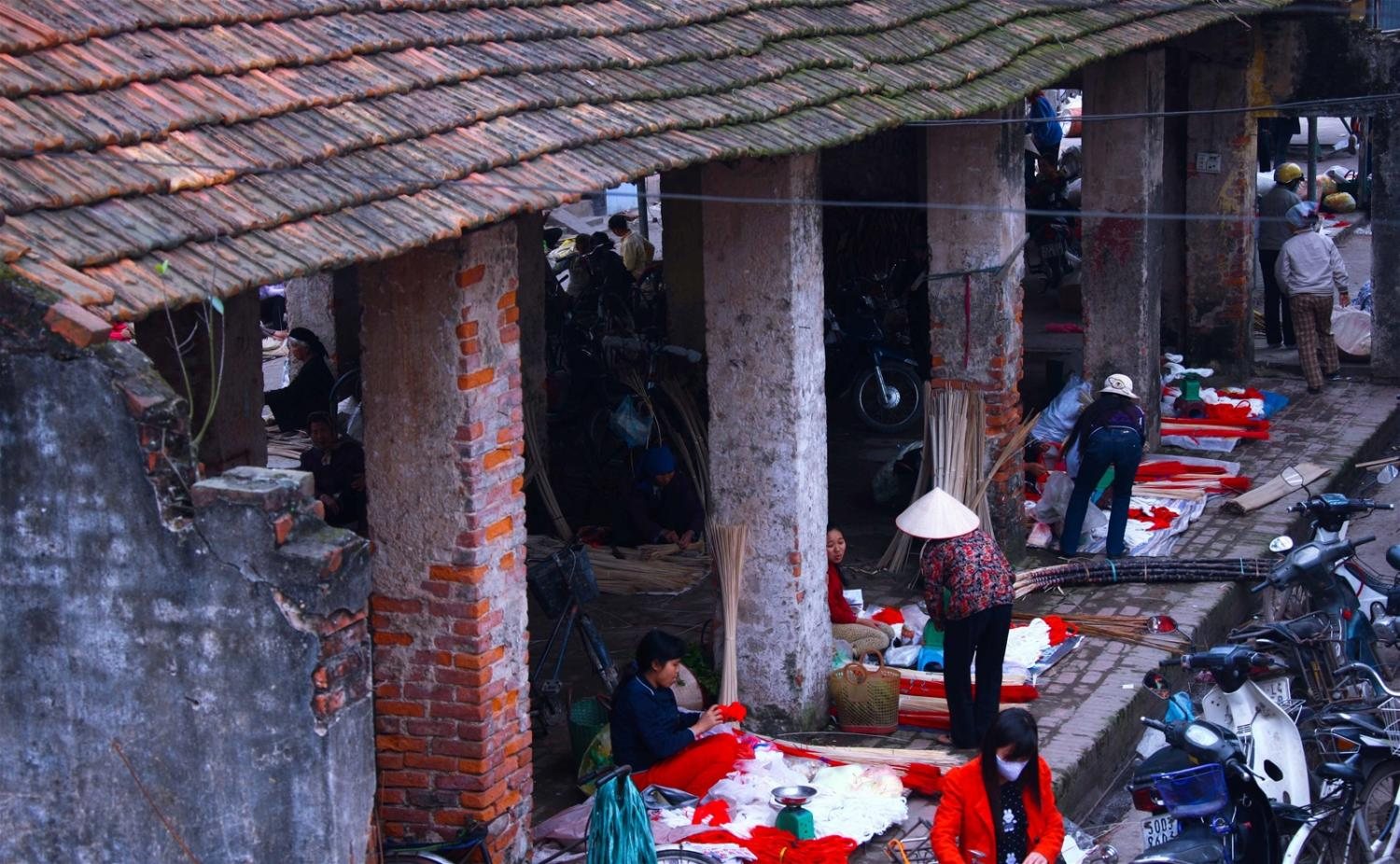
Do not miss the hat market: six sessions a month, opening at six in the morning and dispersing about three hours later, buyers and sellers bustling around stacks of white hats. Come in early spring and you may catch the fair on the tenth day of the first lunar month and the village festival on the tenth day of the third, centred on the communal house built in 1894.
Hiên Nhà Nón will stand right here in the village, so every visit to Chuông has one more stop: to see, to try, and to take home a hat with a story.

04
Three problems, three answers
Talking with friends our age, with women of different generations and with visitors to Hanoi, we found three problems. The plain hat is fragile and easily ruined by rain. An ordinary strap is not enough to make it a fashion accessory. And the hat is bulky and hard to travel with.
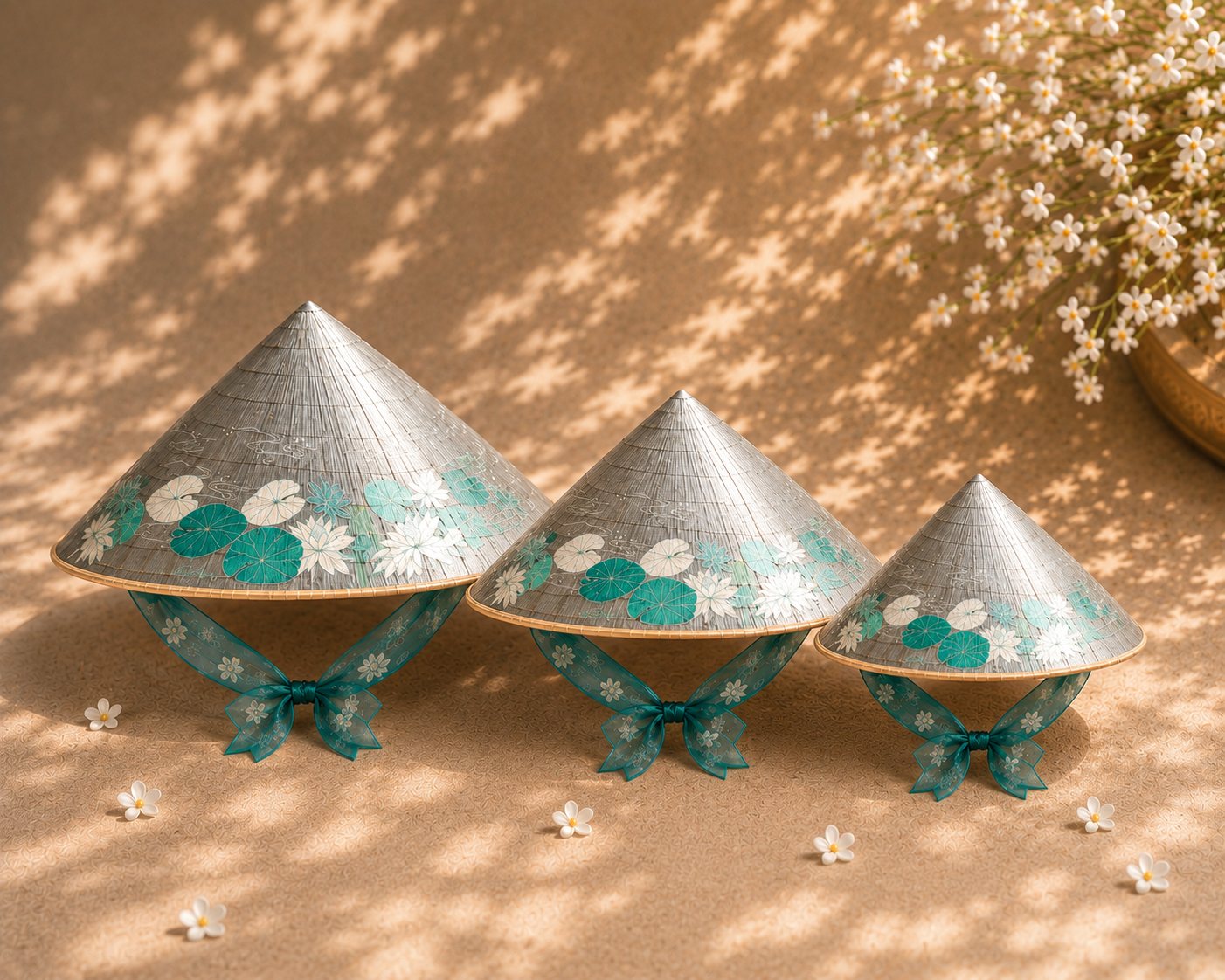
The answers lie in three Hanoi craft villages. Hạ Thái natural lacquer, applied and painted directly on the palm leaves, becomes a waterproof “armour” and turns every hat into a one-of-a-kind artwork. A Vạn Phúc mulberry-silk ribbon serves as the strap and, once untied, becomes a scarf or a headband. And a line of miniature lacquered wooden hats nests neatly together so travellers can take them anywhere.
Fragile — lacquer makes it last. Plain strap — silk makes it beautiful and versatile. Hard to carry — the miniature edition. We do not replace tradition; we inherit it and help it live in today’s world.
05
Three product lines
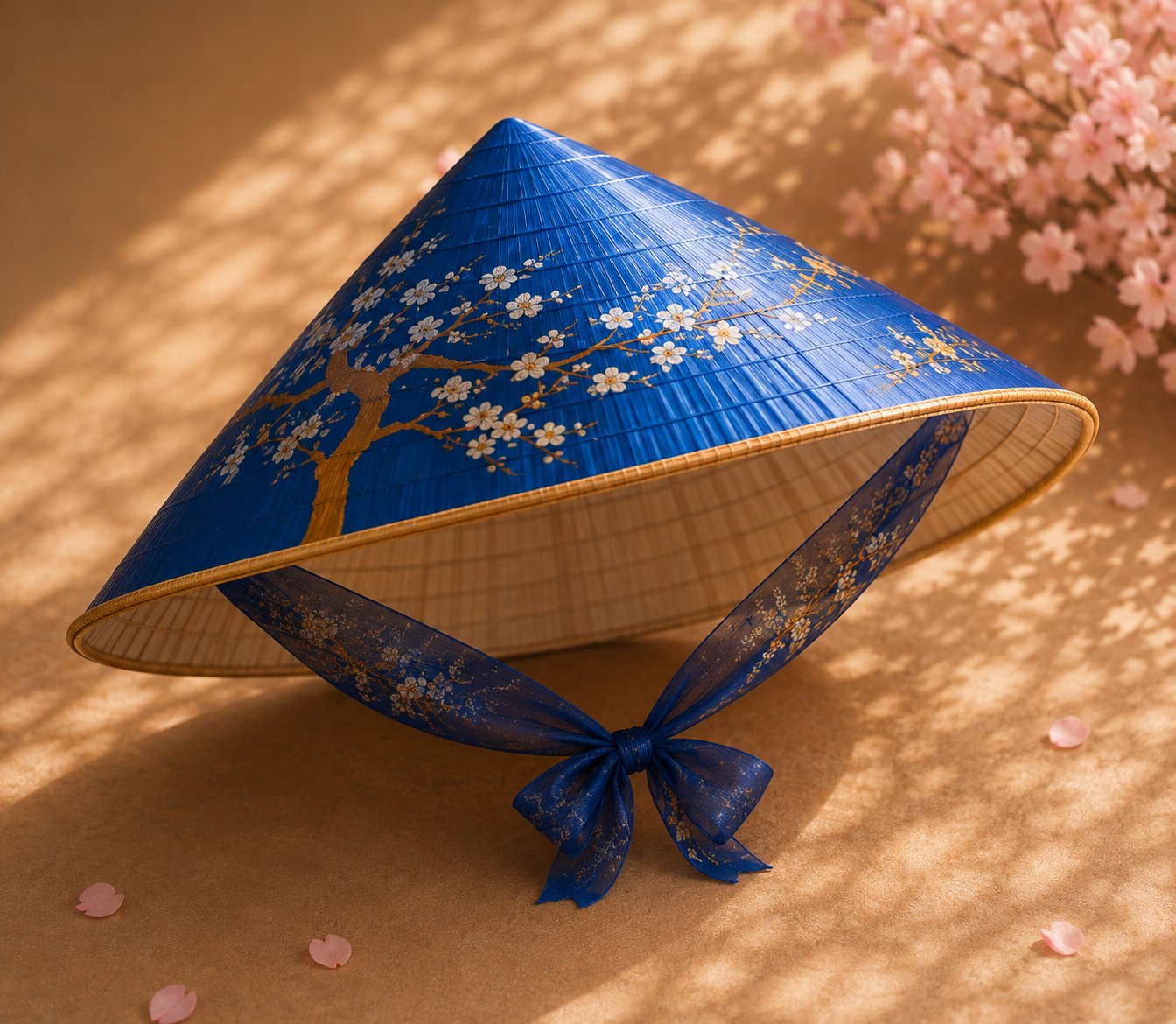
Hats coated and painted with Hạ Thái lacquer. One line uses natural lacquer with silver, copper and gold leaf to render motifs created by the founder; another is silver-leafed and then decorated with lacquer techniques. The silk strap is printed with motifs matching the hat.
Acrylic-painted silk hats. Building on the silk hat created by Chuông artisans — a leaf hat covered in silk and painted in acrylic with the project’s own motifs.
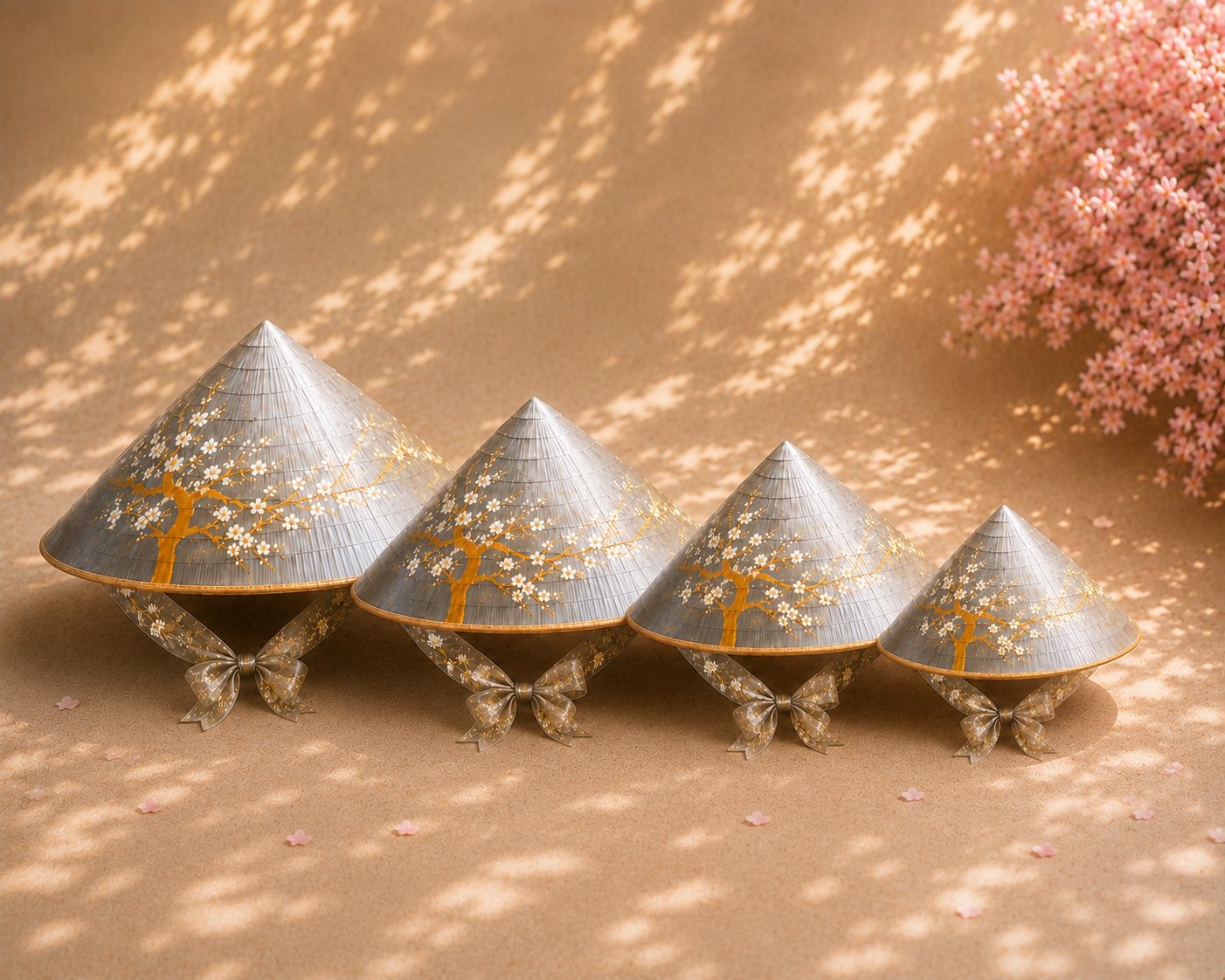
Miniature lacquered wooden hats. A compact, durable souvenir line in sets of 3, 4 and 5 graduated sizes that nest inside one another — easy to ship without damage.
The first three motif families are inspired by snow-plum blossom, peach blossom and lotus. The goal is three debut collections of about 10–20 designs, plus a library of 50–100 motifs inspired by Vietnamese culture, all registered for copyright.

06
Hiên Nhà Nón — the Hat Veranda
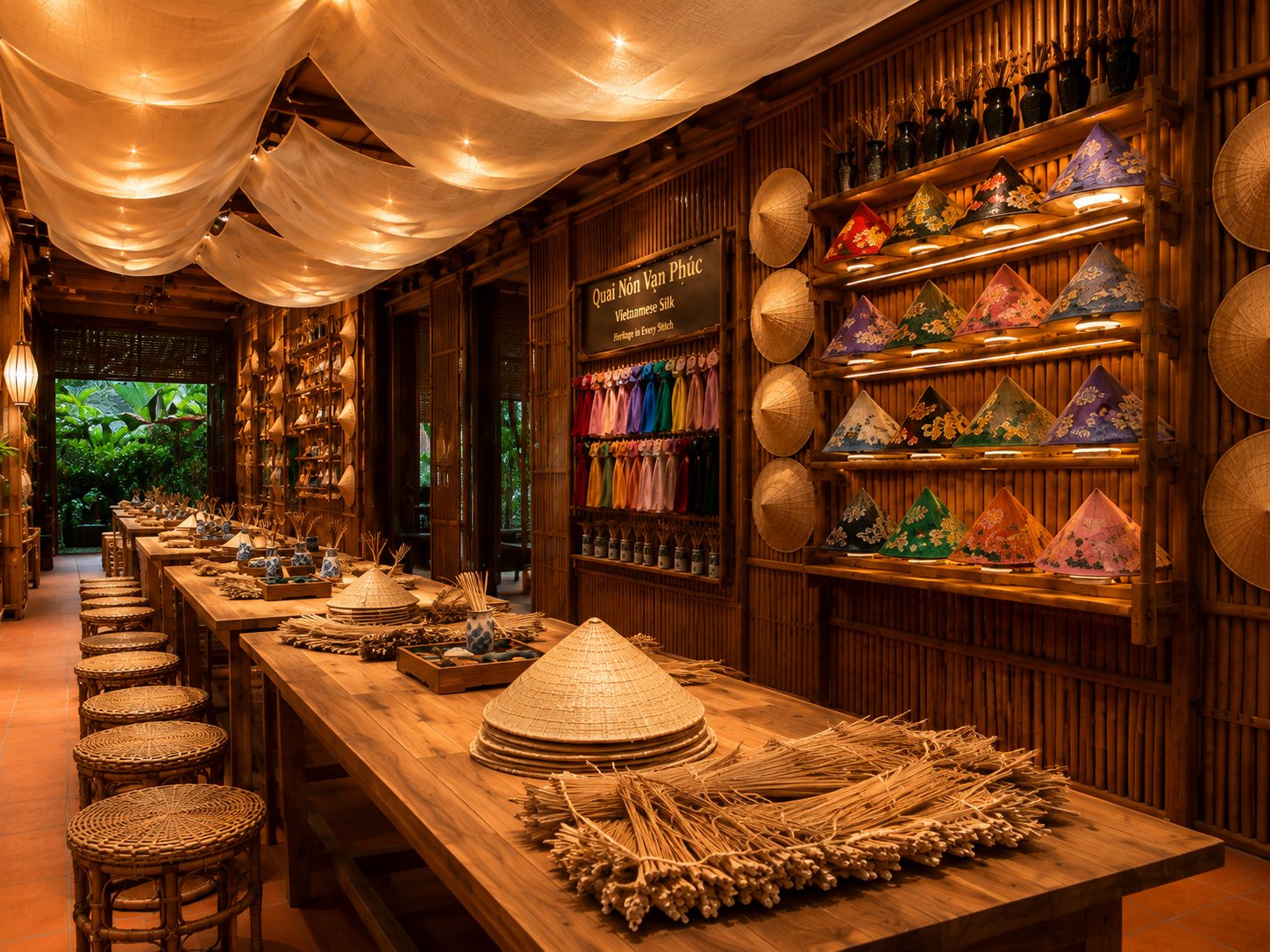
Hiên Nhà Nón is a 120m² art and experience space in Chuông village: workshops, exhibitions, storytelling and a shop for the products of all three craft villages in one destination.
The shape of the hat returns as a canopy of suspended lamps that casts warm, concentric light. Ribbons of Vạn Phúc silk flow through the room to divide it, while tables and plinths finished in Hạ Thái lacquer reflect the glow.
A one-way route leads visitors through three layers of experience. See: the gallery of collections and the heritage wall “One hat – Three crafts”. Touch: the workshop, where guests stitch a hat, paint on leaf and silk hats, try lacquer techniques and choose a silk strap. Keep: the shop and the tea corner, sitting on a wooden daybed and talking with the artisans.
Hiên Nhà Nón also lives online: the website, fanpage and group gather ideas, host an open motif library and carry the image of the Vietnamese conical hat to young people at home and abroad.
07
Empowering women and girls
The main beneficiaries of the project are the women and girls of Chuông village — skilful, yet short of opportunity. Rather than teaching them to make a basic hat, which they already know, the project offers skills that create new value: painting and decoration, colour, lacquer inlay on hats and silk, guiding visitors through the experience, communication and online marketing.
The founder designs the motifs herself and teaches the painting classes, giving priority to girls in difficult circumstances. The first goal is to train at least 30 women and girls and form the “Young Ambassadors of Chuông Village” who work alongside the artisans.
08
A green commitment
All three craft villages work with natural materials: palm leaf, bamboo; mulberry silk; natural lacquer, the sap of the lacquer tree, with eggshell, mother-of-pearl and silver leaf. Chạm Sắc commits to traditional natural materials, keeps industrial paint and harmful chemicals to a minimum, and packs in recyclable paper and cardboard instead of plastic bags.
In classes and in the experience space, students and visitors learn to sort and collect leftover materials. It keeps faith with the soul of the craft, fits the move towards green consumption — and is part of the product’s story.
09
Those who walk with us
The project is guided by artisans and artists from the three villages themselves: People’s Artisan Tạ Thu Hương (Chuông hats), painter Trần Công Dũng — Dũng Dị (Hạ Thái lacquer) and the Triệu Văn Mão silk workshop (Vạn Phúc silk), together with young designers and painters.
The name “Chạm Sắc” carries two meanings: “chạm”, the touch of the maker’s hand and of lacquer; “sắc”, the colour of silk, of art and of youth. Its symbol is the hat seen from above like a full moon, with a silk ribbon curving round it like a musical stave — a nod to the violin and the “symphony” of three craft villages.


10
The hat’s tomorrow
In the long run, Chạm Sắc aims for the model “One destination – the finest of three craft villages”, making Chuông village a signature cultural and creative destination of the capital, one that can be replicated in other villages. Hiên Nhà Nón is meant to become a permanent experience space — a kind of Chuông Hat Museum.
We also dream of evening performances where lacquered hats meet water, light and music — a symphony of colour. Once the project runs smoothly, the whole Hiên Nhà Nón space, the website and the fanpage will be handed over to the local community to keep safeguarding the heritage of the Chuông hat.
Preserving culture is not locking it in a glass cabinet, but keeping it alive.